Characters
Points, archetypes, and ranks
Every character at Eldritch was a basic archetype, a set of skills, and for many an advanced archetype that tied the character to a power in the kingdom.
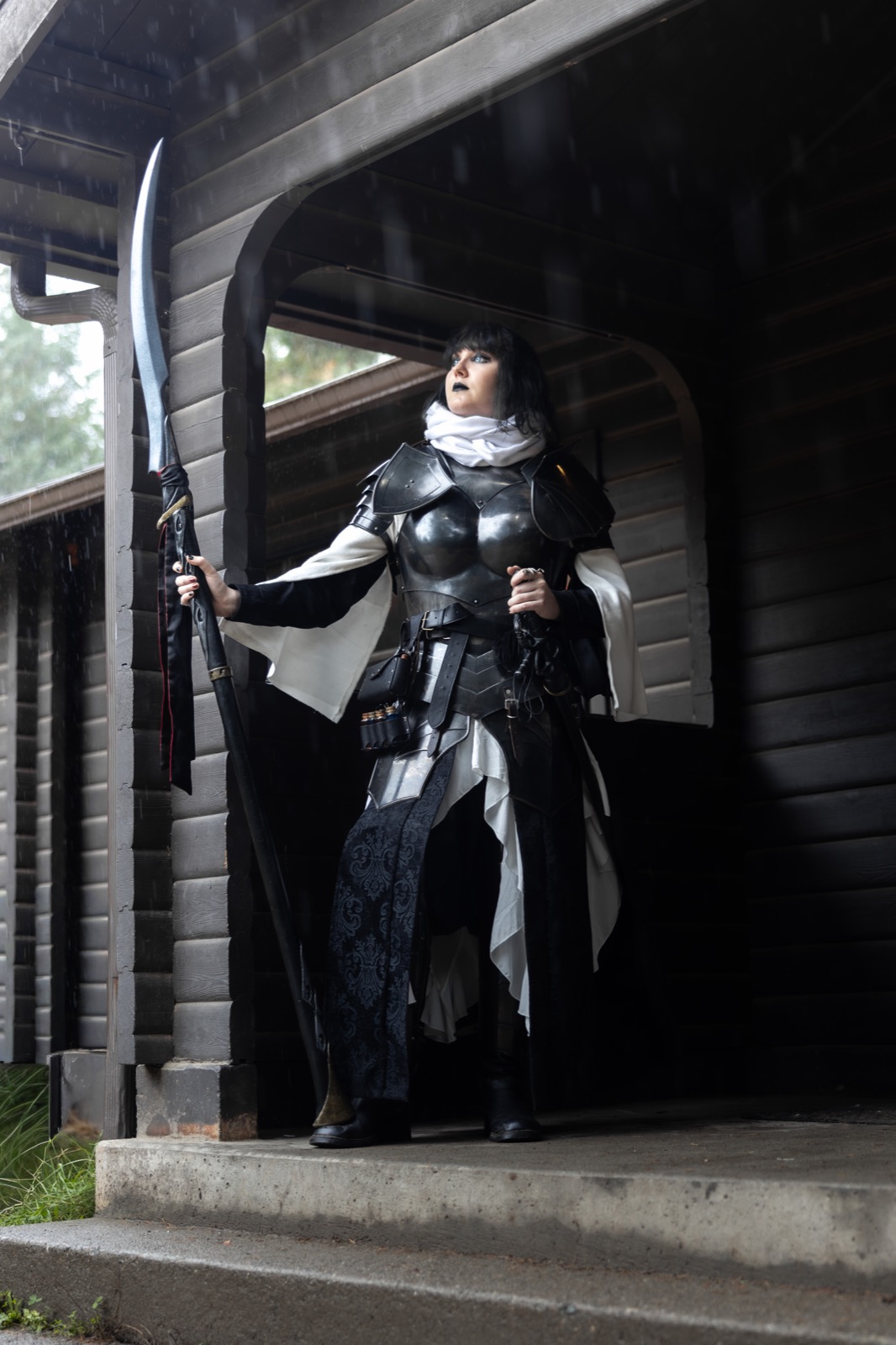
Character Points
Character points, or CP, measured how far a character had grown.
Characters held 4 CP at Event I. Every character earned more after each event, whether or not the player attended, and the campaign closed at 20 CP. Early events were meant to be low level: a character could afford only a couple of skills and was highly specialized. The intended story for each character was one of growth from the bottom upward.
| Event | CP earned after the event | Total CP at the event |
|---|---|---|
| I | 1 | 4 |
| II | 2 | 5 |
| III | 1 | 7 |
| IV | 2 | 8 |
| V | 2 | 10 |
| VI | 2 | 12 |
| VII | 2 | 14 |
| VIII | 2 | 16 |
| IX | 2 | 18 |
| X | None | 20 |
Basic Archetypes
Every character had a basic archetype, which stood for a background and set the first skills and goods. Commonfolk served as the catch-all. An archetype also listed what a patron gained from retaining the character and what that patron paid.
| Archetype | CP | Equipment and coin | Skills | Retainer benefit | Salary |
|---|---|---|---|---|---|
| Apothecary | 4 | 2 Apothecary Kits, 4 level 1 schematics, and resources to craft two schematics | Alchemy - 1 and Herbalism - 1 | 8 Common Herbs | 3 silver |
| Artificer | 4 | 2 Artificer Kits, 4 level 1 schematics, and resources to craft two schematics | Artificer - 1, with Hunting - 1 or Farming - 1 | 8 Cloth or 8 Leather | 3 silver |
| Blacksmith | 4 | 2 Blacksmith Kits, all level 0 schematics, and resources to craft two schematics | Blacksmith - 1, with Mining - 1 or Hunting - 1 | 8 Iron Ingots or 8 Leather | 3 silver |
| Bowyer | 4 | 2 Bowyer or Artificer Kits, both level 1 Bowyer schematics, 2 level 1 Artificer schematics, and resources to craft two schematics | Artificer - 1 and Bowyer - 1 | 8 Refined Wood | 3 silver |
| Brigand | 2 | 8d4 silver dragons in gear and 20 silver dragons | Income - 1, with One-Handed Weapons - 1, Two-Handed Weapons - 1, or Archer | 4d3 silver dragons in wares | 3 silver |
| Commonfolk | 1 | 20 resources of choice and 20 silver dragons | 1 non-crafting level 1 general skill | 8 silver dragons | 3 silver |
| Courtier | 2 | None | One CP to spend on Espionage - 1, Influential - 1, or Income - 1 | 4 Espionage points | 1 Influence |
| Farmer | 1 | 20 Cloth and 20 silver dragons | Farming - 1 | 8 Cloth | 3 silver |
| Feller | 1 | 20 Refined Wood and 20 silver dragons | Woodcutting - 1 | 8 Refined Wood | 3 silver |
| Gentry | 4 | 60 silver dragons | Academics - 1 or Espionage - 1, with Income - 1 or Influential - 1 | 2 Influence | 4 silver |
| Gunsmith | 4 | 2 Gunsmith or Artificer Kits, both level 1 Gunsmith schematics, 2 level 1 Artificer schematics, and resources to craft two schematics | Artificer - 1 and Gunsmith - 1 | 8 Iron Ingots | 3 silver |
| Herbalist | 1 | 20 Common Herbs and 20 silver dragons | Herbalism - 1 | 8 Common Herbs | 3 silver |
| Hunter | 1 | 20 Leather and 20 silver dragons, or a bow and 2 quivers of arrows without coin | Hunting - 1 | 8 Leather | 3 silver |
| Merchant | 2 | 40 silver dragons | Income - 1 and Gathering - 1 | 8 silver dragons | 3 silver |
| Miner | 1 | 20 Iron Ingots and 20 silver dragons | Mining - 1 | 8 Iron Ingots | 3 silver |
| Physician | 2 | 2 Chirurgeon's Kits and 20 silver dragons | Diagnose - 1 and Medicine - 1 | 2 Influence | 4 silver |
| Scholar | 2 | 10 silver dragons | Academics - 1 and any level 1 lore skill | 2 random level 1 lore props | 4 silver |
| Soldier | 2 | 50 silver dragons, 40 of them spent on weapons or armor | Two of One-Handed Weapons - 1, Two-Handed Weapons - 1, Archer, Tough - 1, or Shields - 1 | 4d3 silver dragons in wares | 3 silver |
| Urchin | 1 | 20 silver dragons, with 4 Influence or 2 Lockpicking Kits | Espionage - 1 or Disable Device - 1 | 4 Espionage points | 1 Influence |
- Courtier could be granted only by a Noble and could replace any other archetype. Courtiers paid 10% less for rank increases while retained by a Noble.
- Gentry paid 25% less for all rank increases.
- Artificers, Blacksmiths, and Merchants could be retained by the Cirque only. Bowyers could be retained by the Cirque or by Innis Nobles with the applicable skill.
- Gunsmiths could be retained only by Richter Nobles with the Pact of Old skill.
- A Scholar's retainer benefit could be redrawn if it duplicated a lore the retainer already owned.
Advanced Archetypes
An advanced archetype marked membership in a guild, faction, or order, and it opened a set of skill trees. A character added one on top of a basic archetype. The Veteran archetype covered everyone outside those bodies.
- Auron
- Aurons were the religious leaders of the Aurorym, a faith built on personal power and inherent strength. Anyone could follow the faith, but becoming an Auron took training and religious aptitude.
- Cirque
- The Cirque were the economy of Arnesse. Once a traveling band of performers, the Cirque and its gangs held sway over trade from the Everfrost to Tarkath.
- Knight
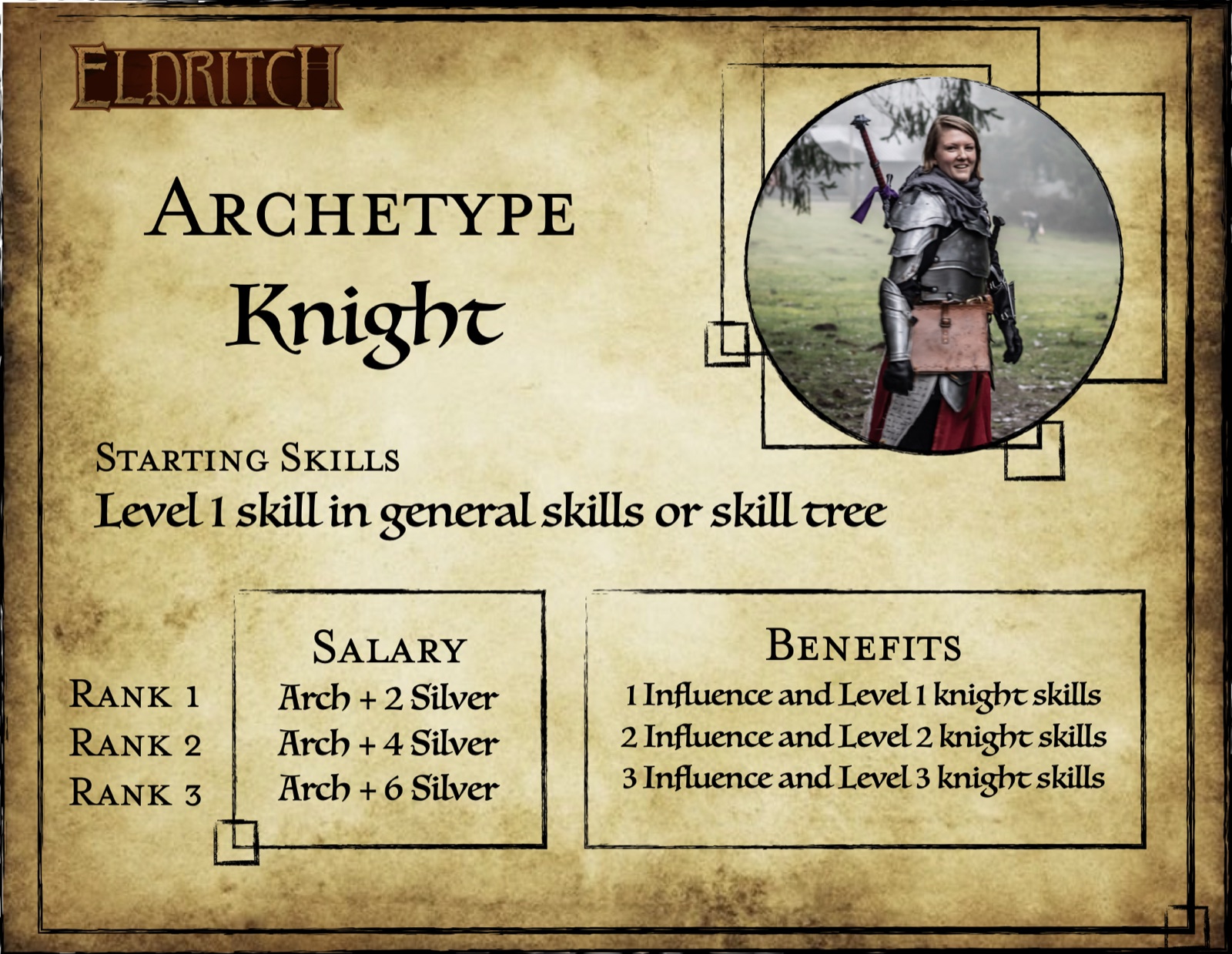
- Knights were the specialized martial force of the nobility and the high houses, proficient in all manner of weapons and armor.
- Magister
- Magisters belonged to the Order of the Apotheca, an ancient order of doctors, alchemists, and scholars. Its Apotheon in High Court was the oldest institution of higher learning in the kingdom.
- Noble
- The nobility of Arnesse and Tian Zhou ruled their own corners of the realm through cunning and coin.
- Veteran
- Veterans were skilled and trusted members of a community: crafters, gatherers, warriors, managers of people, and a few who were merely very good at being shady.
- Vigil
- The Vigil was an ancient organization of mostly unlanded and untitled nobles, who served the nobility as bodyguards, advisors, and lawgivers.
| Archetype | CP | Basic archetype required | Added retainer benefit at Ranks 1, 2, and 3 |
|---|---|---|---|
| Auron | 3 | Any basic archetype except Courtier or Gentry | 1, 2, or 3 Influence |
| Cirque | 3 | Any basic archetype except Courtier or Gentry | 4, 8, or 12 resources |
| Knight | 3 | Gentry, Physician, Soldier, or Courtier | 1, 2, or 3 Influence |
| Magister | 3 | Scholar, Apothecary, Physician, Gentry, or Courtier | 4, 8, or 12 resources |
| Noble | 6 | Courtier or Gentry | 1, 2, or 3 Influence, or 4, 8, or 12 silver dragons |
| Veteran | 1 | Any basic archetype | 8 or 12 resources or silver dragons, at Ranks 2 and 3 only |
| Vigil | 3 | Courtier or Gentry | 2, 4, or 6 Espionage points |
Retained characters with an advanced archetype also drew a higher salary. It rose above the basic salary by 2 silver dragons at Rank 1, 4 at Rank 2, and 6 at Rank 3.
- Aurons with a 1 CP basic archetype paid 15% less for rank advancement.
- Cirque with the Merchant, Blacksmith, Artificer, Bowyer, or Urchin archetype paid 15% less.
- Veterans with a 1 CP or 2 CP basic archetype paid 10% less.
Ranks
Advanced archetypes had ranks, and a character's rank set which archetype skills could be bought. Rank advancement cost Influence, which the player turned in to staff. A character could rise one rank per event. Discounts used true rounding.
| Rank | Cost | Benefit |
|---|---|---|
| 0 | The archetype CP cost | One free level 1 skill in the primary or general tree, and all Rank 0 skills |
| 1 | 12 Influence | All Rank 1 skills |
| 2 | 16 Influence | All Rank 2 and Signature skills |
| 3 | 20 Influence | All Rank 3 skills |
Retainers
Some advanced archetypes had skills that granted retainer slots. Retainers were the entourage of a character, and both sides gained from the arrangement. A retainer handed over an archetype card, and the patron kept it for as long as the employment lasted. Either side could end the arrangement, and the card then went back to its owner.
Each card listed a Salary and a Benefit. The patron was responsible for paying the salary each event and presented the cards to staff at check-in to collect the benefit.
| Archetype | Could retain | Could not retain |
|---|---|---|
| Auron | Any basic archetype except crafters and Merchants, plus Veterans, Knights, and other Aurons | Cirque, Magisters, Nobles, or Vigil |
| Cirque | Any basic archetype except Gunsmiths, plus Veterans and other Cirque | Aurons, Knights, Magisters, Nobles, or Vigil |
| Knight | Brigand, Commonfolk, and Soldier archetypes, and Veterans with those archetypes or the Soldier tree as primary | Aurons, Cirque, Magisters, Nobles, Vigil, or other Knights |
| Magister | No one | Anyone |
| Noble | Any basic archetype except crafters and Merchants, plus Aurons, Knights, Magisters, Veterans, Vigil, and Nobles of lower rank. Richter Nobles could also retain Gunsmiths, and Innis Nobles could retain Bowyers. | Cirque |
| Veteran | Brigand, Soldier, and Urchin archetypes, and Veterans with those archetypes | Aurons, Cirque, Magisters, Nobles, Vigil, or Knights |
| Vigil | No one | Anyone |
Some Veteran skills could use an unretained archetype card for check-in bonuses, after which the card went back to its owner.
Standard of Dress
Eldritch held its players to set standards of costume, which were part of the production itself. The following were not allowed as part of a costume.
- T-shirts, jeans, khakis, and other obviously anachronistic clothing.
- Uncovered modern footwear.
- Any visible anachronistic device, such as a watch.
- Real weapons, and anything else that could do real harm to another player.
Staff also encouraged a scabbard for any weapon that suited one, in place of a belt or frog.
General Interactions
Any character could perform these actions without a skill. All of them fell under the check-in system and the rules for conflict between players on the Conduct and Safety page.
Theft
Characters could steal coin and the tags that represented items. Physical props were never stolen, and nothing was taken from out-of-play spaces such as shared bathrooms. A container in a character's lodging could be marked out of play with a note or an orange band.
These items could not be stolen or looted:
- Influence and Espionage.
- Lockpicking Decks, although Lockpicking Kits could be taken.
- Lock tags on or beside the thing they locked.
- Signed lores and signed schematics.
- Construction Blueprints.
Searching
A character could search a dead or incapacitated character or NPC by miming a search on a three count. Physical contact needed permission beforehand. Weapons, armor, and equipment on an NPC could be looted only if an item tag represented them, and most NPCs carried none.
Sneaking
Any player could attempt to sneak to the best of their ability. No skill or mechanic governed it.
Carrying Other Characters
A character was carried by wrapping the character's arm over the carrier's shoulder and walking slowly. Players who did not want physical roleplay walked slowly side by side instead. Only one character could be carried at a time.
Binding and Restraints
Binding needed out-of-character permission, or the players could use the Fade to Black. Rope had to be loose enough for the bound player to remove it. A character left bound and unattended for more than an hour could escape. Plastic manacles sold as Halloween props were the recommended restraint, because they looked right and came off easily.