The Northern Marches
A protectorate of ArnesseHouse Innis
The Thornwood is a realm apart from the kingdom, home to an old people who remember what was done to them. Those who stray from its paths are rarely seen again.
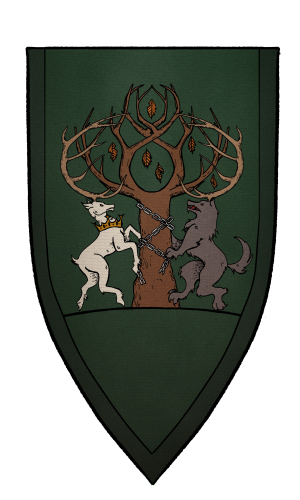
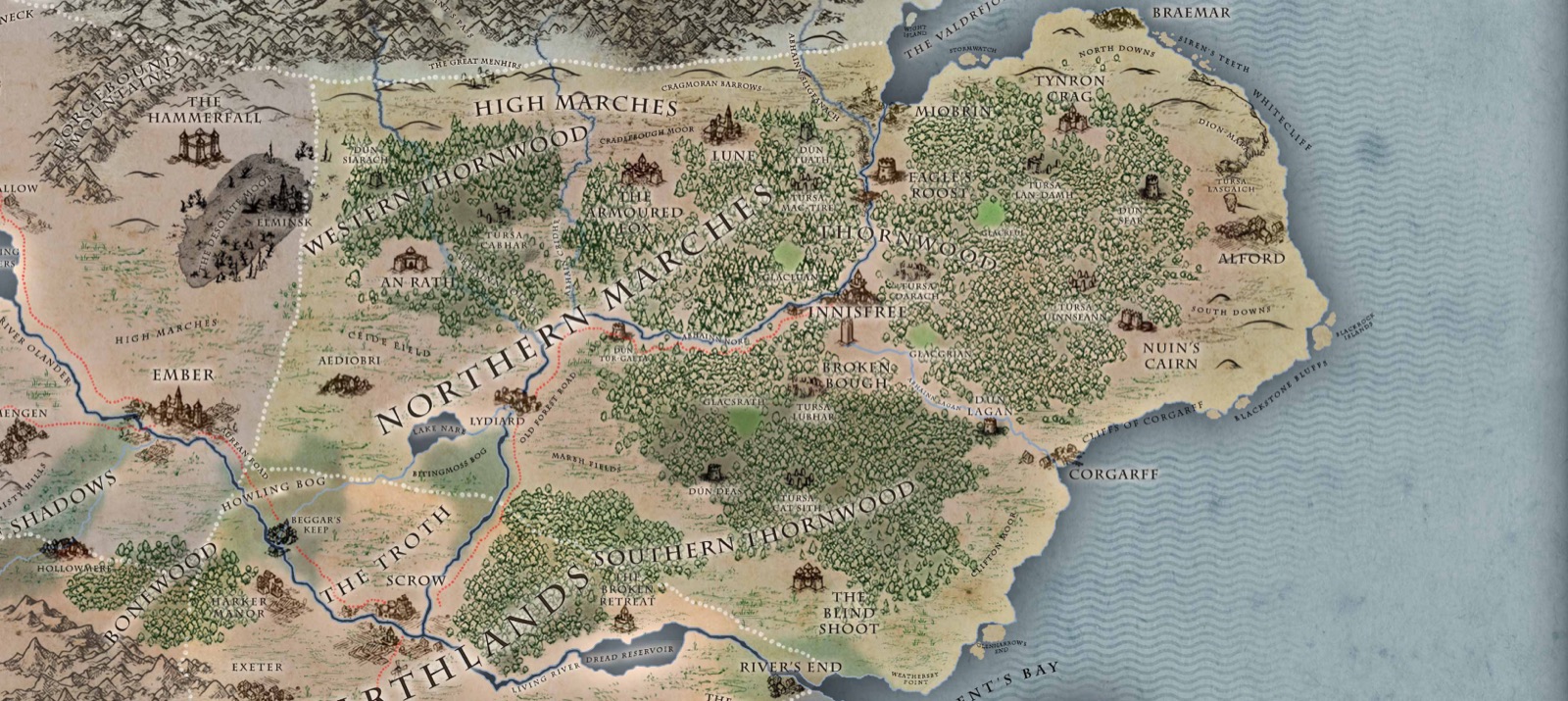
The Land and Its People
The Northern Marches lies between the Dusklands, the Everfrost, and the Hearthlands, and the Thornwood covers most of it. The winters are short, rainy, and gloomy, and mist is a common sight in the forest and on the moors.
This page describes the protectorate as it stood in 763, when the Annwyn appeared. The last section follows what became of its people there.
The Woodfolk are among the most ancient peoples of Arnesse and the most reclusive. They seek to live in harmony with the land, and the idea of industry has long been all but forbidden in the wood. Their logging is limited. Their flat farmland outproduces even that of the Corveaux and the Blaynes, but they export little and stockpile the rest, so few in the Marches go hungry.
The old arts of shaping plants and beasts are gone. Careful breeding has replaced them, and House Innis keeps some of the greatest stores of medicines in the kingdom. Its scouts are superb trackers. The Fair Folk, called the Aos Sí in the old tongue, are as real to many in the Thornwood as anything else in life.
The Fall of Medeina
House Innis was once House Athan, led by the immortal twins Bridgit and Innis. Innis built the city of Innisfree out of the living wood. Then came the Darkest Night, when the faithful of the Old Gods were dragged from their homes, the groves were burned, and the priests were sent to die in camps.
The armies of Richter and Hale came next with iron and cannon. At the sacred grove the twins fought themselves, and Innis fell. Bridgit could only watch as the Athan, the most sacred relic of her people, was burned and the goddess Medeina was drawn out of it. The eldritch cannons of House Richter fired into her for almost half an hour, and she wept and did not fight back. The Woodfolk have called the Richters Godkillers ever since.
Bridgit withdrew to the Eternal Grove and slowly became entombed in the tree at its heart. House Bannon's troops occupied the forest for more than a hundred years, a time called the Bitter Harvest. King Roland I restored the house to good standing in the seventh century, and it took the name of its greatest builder.
The Marches in 763
Feeling against King Giles II ran high. He was a Bannon, he followed a faith the Woodfolk loathed, and he was held responsible for the public execution of Queen Maeve, the sister of Lady Paragon Bodhmall Innis. The Thornwood had restricted its borders and had been preparing for war ever since.
Another war had already come. Richter forces and commoners from Elminsk were raiding the Western Thornwood for lumber, and the Woodswards were fighting the Iron Guard among burning trees. The Crown showed no interest. The number of Woodfolk traveling beyond the forest had grown more than at any other time in their history, and many had begun to think that their future lay outside it.
The High Houses
House Innis of Innisfree
Innisfree holds almost forty thousand people, the largest city in the Marches, built so far into the forest that it is hard to tell where one ends and the other begins. Those with enough coin may pay to visit. Its Living Market passes goods from the outside world deeper into the wood.
House Brevis of An Rath
Onora Innis trains birds of prey and organizes trade with the Cirque, and her house stands at the border where Richter raids are worst.
House Ebora of Eagle's Roost
Wilem Ebora holds the great ford of the River Nore and the port of Miobrin. Young warriors settle disputes by racing up the falls below the ford, which often kills one or both of them.
House Annalee of the Blind Shoot
Kassity Annalee cares more for her gardens than for her office, and those gardens have brought back herbs once thought extinct.
House Verubri of Nuinn's Cairn
The Verubri hold the largest silver mine of the Marches and are master silversmiths. They are among the few high houses with no descent from Bridgit and Innis.
House Gleanna of Tynron Crag
Coleen Gleanna, a cousin of the ruling family, holds the northeastern woods.
House Oban of the Armored Fox
The most martial of the vassal houses guards the northern border, and its ruler bears the name of his castle. Firas Oban is swift, cold, and hateful of outsiders. The great wargs are bred on his land at Lune.
The Ways of the Wood
The Groveskeepers
The head of House Innis is always a woman, as Bridgit's representative to the world, yet she speaks for a council. The Groveskeepers meet behind closed doors at the Broken Bough, a keep of woven stone and wood whose towers end in blackened spires. Their seats are the wooden cathedrae of the Eternal Grove, and the Oak Cathedra belongs to the Lady Paragon.
The Orders
Woodswards are chosen young and raised in the order, and the finest archers among them become Knights of the Ivy. The Wolf Guard ride the great wargs, under Aina of the Red Teeth. The Guardians of the Root train for more than a decade to hold the songs and stories of the house. The Draíochta, once the Priests of the Wood, are few, secretive, and powerful.
Customs and Holidays
Families dedicate one child, usually the eldest, to the forest, and that child is raised by a community order. A child who has begun to speak is brought before the Draíochta on Naming Day, in the eighth moon. In the second moon, children hang lanterns in the branches for the Return of Light. White flowers fall at Innisfree in Blossom Season. At the fall equinox, Bridgit's Day ends with a doll of Medeina burned on a pyre. On the Feast of the Fallen, the veil between the worlds is thin enough for divination in wax and water.
Legends
A white hart is said to draw hunters deep into the wood, to the margins of the Otherworld. Jenny Greenteeth pulls the unwary under the water. On the coldest nights Woaden, a lost king of the Thornwood, sounds the horn Carnyx and leads the Wild Hunt, with the great hounds called the Cwn Annwyn at his side.
Attire
Clothing in the wood is meant to blend with it. The colors are natural greens, blues, yellows, browns, tans, and black. The Woodfolk enjoy embroidery and favor images from nature. Hoods and light cloaks are popular among all classes in the rain.
In the Annwyn
From the first, it was rumored that the Innis had a settlement named Goldleaf in the Annwyn and that they were arming the Crows. In the spring of 765 House Oban attacked Carran and Stag Hall with help from a traitor inside. The town burned nearly to the ground, and House Laurent never recovered. Lord Niall Oban then pardoned the Crows and took them into the Innis army.
Mystvale tried the Obans that autumn and found them guilty. The Obans agreed to pay restitution to the survivors of Carran. After the King died they fell back to Goldleaf, where Roderick Wolf, once called Hammond the Talon, was proclaimed Giles the Third, the Woodsworn King, with House Innis behind him. The Royalists beat the Woodsworn host at Mystvale in the spring of 767.
Goldleaf fell to Oblivion in 767. Survivors later said that the banner of the Woodsworn King flew among the dead and that he now led their armies. The Chronicle follows the Obans from Event IV.