The Precipice
Prologue to Event VIII4th moon, 767
The prologue to Event VIII followed the long winter after the death of King Giles II and set out the four armies that met in the spring of 767.
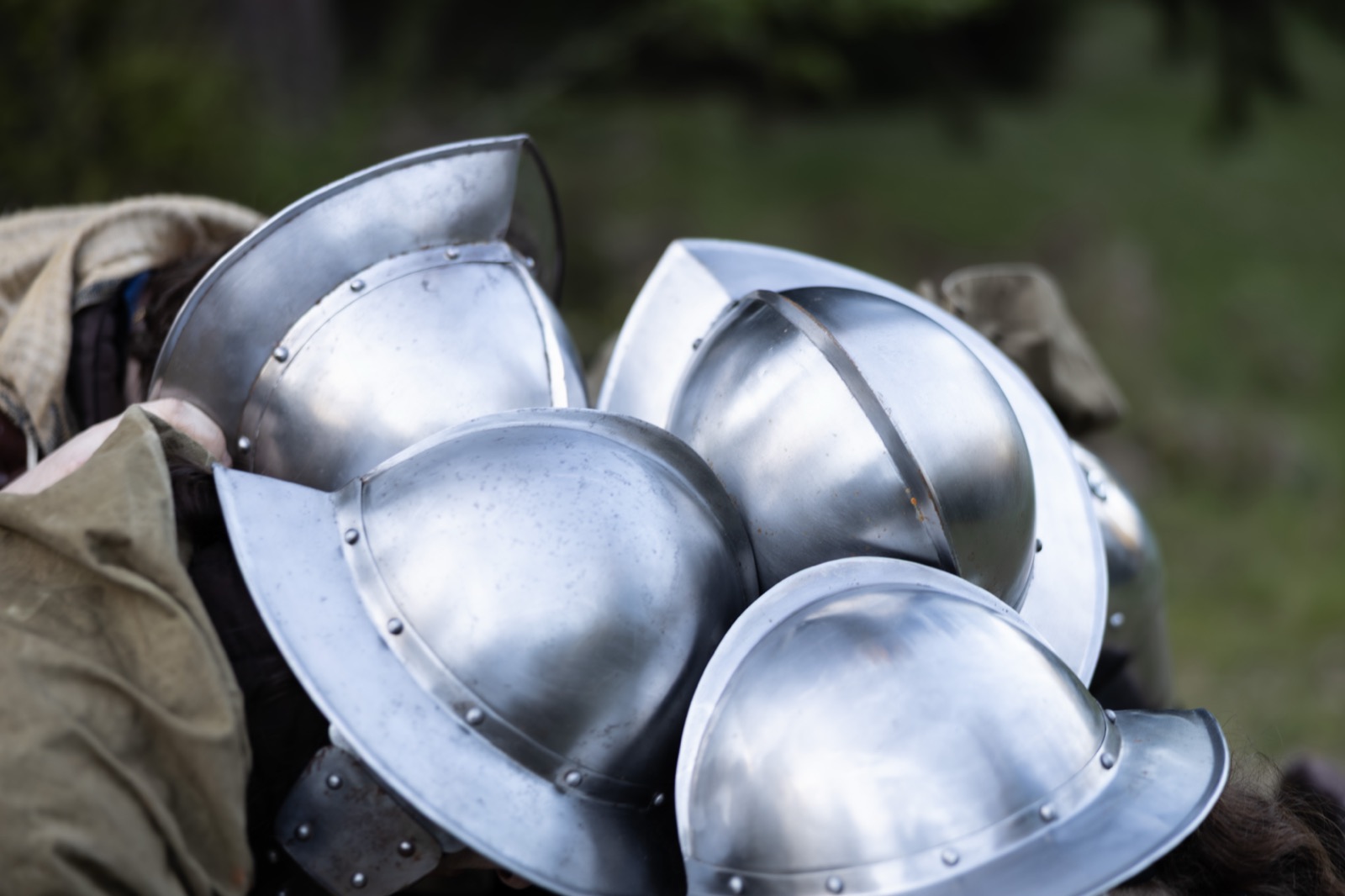
“I turn to right and left, in all the earth I see no signs of justice, sense or worth.”
The prologue referred readers to the History of the Annwyn, which is now on The Annwyn page. Its sections on town buildings, on travel, and on where characters could live are left out. The rest appears as it was written, with two typing errors fixed.
Recent History
The 10th moon of 766 did not end well for denizens of the hamlet called Mystvale.
In the square at Mystvale, the traveling players of the Grande Cirque Obscura performed their final act of the season. What stepped from behind the torn glamour was not the main act at all, but a construct of bone and plague wearing a face that belonged to something older. The townsfolk cut it down by hand and by fire in the light of the braziers. Volgrim himself — the Master of Revels — was neither among the dead nor among the living when the dust settled; he had passed back into the mirror from which he came. His tents came down by morning. The Grand Cirque Obscura spent the next season traveling across the Annwyn without significant incident, and without visiting Mystvale.
The scroll recovered from the Tower of Menethil still resists translation. And worse than any of it: the King came to Mystvale. Giles II crossed the Mists on a matter of state, and he did not leave them. He was cut down by one of his own Vigils – Simon Bannon - the men who had sworn to keep him breathing. The blade was poisoned. The man who had held it was never found. Within a season, the Queen Regent Aline Bannon had proclaimed her son Cyrus the rightful heir of the realm; and within that same season, four banners had risen across the Annwyn. Houses that had sworn themselves to one crown were sworn to four.
The Long Winter at Mystvale
The barracks near the market burned in the night, and the fire found the roof faster than the buckets found the flames. Royalist men were lost. Desertion began quietly afterward — in twos and threes at the edge of torchlight, unmarked and unprotested, because noticing meant choosing. By the third moon of 767, the town had stopped asking where its soldiers had gone. Grain in the storehouses turned rancid in the sack. What could be milled was milled, but most did not keep. The Blackhammers came with writs and steel and took what was fit, and the town pretended not to notice because noticing would have meant refusing. The market shrank. People stayed home to count what was left.
The chantry was scored in the door and smoked in the rafters, and when the aurons opened the offering room they found the coins trampled under dirt and dust, and the altar cloths cut to ribbons. They scrubbed the stone with salt water until their hands bled. They kept wary vigils, without joy, and they did not stop. When the steel ran short, they sat with awl and sinew and patched torn jacks by candlelight, because sermons did not stop arrows and the Dawnguard at the fence had bled the length of the season.
The Tarkathi and Twilight Empire manors burned to their stones. The farmsteads along the road followed, one by one, and the hunting grounds were picked clean until even the crows grew thin. Wagons stopped traveling alone. Then they stopped traveling at all. Mystvale endured. No banner defended it. The people in it simply would not leave the ground they knew.
Other Shadows
A new quietness has begun to spread across the Annwyn. The Calicans do not preach, do not threaten, only listen. Priests who debate them lose their voices. Nobles who argue with them lose arguments they had expected to win. At night, in small rooms, some among them have been heard praying — not to any Saint, nor to any God, but to a name - Calico.
Something continues to move in the old wood. A pack that moves through the deep places in columns, hunting the way soldiers hunt. Red Barnabus, the alchemist who went into the den last autumn to cure them, has not come back. And neither has Magister Cornelius who came to Mystvale looking for them. Trappers who still work the far hedgerows speak of crude stone altars raised among the trees, and of bodies left at their feet, seemingly beaten to death by one another. The hunters who have seen them say the consecration is not yet done.
A new voice has begun to move through the Aurorym of the Annwyn. One Auron Ezekyle, who lets others name him the Sanctifier. His Chosen of Magnus — the poor, the outcast, the faithful whom the houses never fed — answer to no lord and have begun to break from the ranks of the Royalist coalition where it suits them. Ezekyle has begun to say the saints of Mystvale were never the houses' to keep. He is said to be bound for Mystvale, though how long that will take is anyone’s guess.
Lord Wilhelm Hardinger has not spoken a kind word since Ludmilla Laurent died, and the Laurent line is finished. He has thrown his weight behind his daughter Vasha now — her Blackhammer columns march with Hardinger coin and Dusklander steel, and the old man's grief marches with them. Some whisper the Hardinger accounting with the Obans has not yet come due, and that when it does, it will come quietly — in a cup of wine or a blade between the ribs, not on any battlefield.
The Corveaux hold their ground, and their Falconer allies with them, but the camps are quieter than they were. They have begun to speak openly of what they once only whispered — a hidden heir of a lost bloodline, a blade waiting to return, a king promised for an hour such as this. Two knights in silver, twins, are said to ride among them now, and to speak of signs seen in still waters.
Dawnhaven endures on the thinnest margin. Matriarch Thea's council holds the city together, but the granaries are half-empty, the hymns are dim, and the hand that held the torch to the settlement last season has not yet been answered for…
The season of quiet suffering has ended. The armies are moving.
Current Events
Four Banners, One Road
The winter's quiet was a kind of accounting. What each of the four contending banners gained, and what each lost, became legible as the thaw came on.
And now that the roads are dry, the armies are moving once again.
The Dawnguard - Matriarch Thea rides at the head of the Royalist column with Lord Alion Cornwall at her right hand, and Curate Cyrus behind. The host is well-armored. Its ranks are zealous. Its discipline did not break under the shortages the winter imposed. Of the four armies, it is the most ordered, and its hard core refuses to bend. It marches with the faith of the realm behind it — though how much of that faith still answers to the realm is another question entirely.
The Blackhammers - The largest host in the Annwyn, its banners stretching further than any eye cares to count. Hawken Richter's claim on the throne rests on that breadth. General Vasha Hardinger drives the column forward with Hardinger coin at her back. The Godslayers march in it now — armored, drilled, in column. And yet the host is blunted at the edges. More boots than bread. Its captains feed fewer men in the evening than they muster in the morning. But they march.
The Woodsworn King, Giles III – The Crows still drill in the deep wood. Giles the Third, the Woodsworn King, crowned at Goldenleaf, calls them his own, and House Innis stands with him. Among them now are men who once answered to Cornwall and Thea; the winter sent them westward through the tree line in twos and threes, and they did not go back. They are the smallest of the four armies, and the meanest. They live off what the land still grudges them and slip through hedgerows no heavier army can follow.
The Dragon King, Charles Bannon - Charles Bannon's banner of serpent and sun holds the south-eastern Annwyn. His disciplined retainers are mustered; Aragon archers drill to distances other armies cannot match; lances move like a hammer when they choose a nail. Envoys of the Twilight Empire — travelers in silks from across the eastern sea — ride openly among them now and sit at their tables. What they have come to offer, or to ask, remains a question.
Mystvale - The town sits at the fulcrum. A chantry scored though still standing. A market of patched boards. Among the ashes of the razed garrison, a new one rises. Uncommitted houses — Rourke and Hale — watching from harbors and keeps unnamed. The roads are full now, and not with traders. Farmhands carry children on their shoulders. Old men carry blankets. The wounded limp behind. Every captain in the Annwyn has worked out that the town sits at the fulcrum. Every captain has begun to move.
No one doubts what comes next.
Decisive Moments
Which banner will you raise in the coming war?
The question found its way to every table in Mystvale in the moons after the King's death — in open council and quiet conspiracy, in coin laid and coin withheld, in letters written and letters burned. Each faction drew the support its friends could give it, and the sabotage its enemies could afford. The balance of those quiet efforts — favors lent and favors undone — decided not only which banners drew new strength, but what each banner would look like when it took the field: the size of the host, the quality of its arms, the discipline with which it could be brought to bear. Six moons later, the answers showed plainly.
The Royalist Coalition - Led by Matriarch Thea at the head of the Dawnguard, with Lord Alion Cornwall at her right hand and the curate Cyrus carried among them as a living reminder of what the Dawnguard believes it fights for, the Royalists emerged from the long season the most ordered of the four. Their barracks at Mystvale burned — troops were lost, desertion followed quietly — yet what remained closed ranks. Where the Aurorym walked, torn mail was mended and wounded jacks patched at the altar by aurons who had learned that sermons did not stop arrows. The Dawnguard line holds. A hard core that refuses to bend, even under hunger. The host now stands at Carran, where the bridge is, and the Blackhammer column has come for it. If Carran holds, the Royalists keep the river closed and buy Mystvale a season it would not otherwise have. If it falls — whether to the walls breaking or to the granaries emptying first — the bridge opens, the road south and west along the river opens with it, and the war comes to Mystvale in the Blackhammer host's wake.
The Blackhammer Host - Led by General Vasha Hardinger, daughter of Lord Wilhelm, the Blackhammers carried the winter as the largest faction in the Annwyn, and the cost of carrying it was felt in their wagons before it was felt anywhere else. Grain turned pale and soft in the sack. What could be milled was milled; what could not was left, and then taken from whoever still had a storehouse. Their captains fed fewer men in the evening than they mustered in the morning. Of the houses who carry the Blackhammer banner, the Hardingers bore the grief of the season hardest — and bear it hardest still. Vasha's columns now stand before the walls of Carran at Longbridge, where the Royalist host of Matriarch Thea and Curate Cyrus holds the faithful ground. If Carran falls, the road south and west along the river is open, and the Blackhammer march will bend toward Mystvale as the other banners are bending toward it already.
The Woodsworn King - Giles the Third - “The Woodsworn King” - called Hammond still by the men who rode with him as mercenaries before the crown — at the head of his Crows, the soldiers of Lex Talionis, and the Northern Marcher columns that House Innis has raised for him, the Woodsworn are the smallest faction and gained what no other faction gained. After the barracks fire, some of the desertion-tide from Mystvale slipped westward through the tree-line; after the grain rot, hungry men listened to those who spoke of a king who remembers what it is to be cold. What they did not gain in numbers they gained in posture — meaner, forest-bound, slipping through hedgerows where heavier armies cannot follow. The host moves now from Goldenleaf, south and east to take the Dragon King's Aragon holdings before they can be reinforced. If the Aragons break, the Woodsworn will not stop there. They mean to come down to Mystvale in time to meet whatever remains of the host that wins at Carran — not as the largest army on the field, but as the freshest.
The Dragon King - Led by Charles Bannon himself - the Dragon King, who claims his half-brother’s crown as the realm's rightful heir - at the head of the Aragon lances and the southern retainers bent to Moonfall, the Dragon King's faction paid for its position in burned manors. The Aragon hall in Mystvale and the Twilight Empire's were the first to go; outlying farmsteads and hunting lodges followed. What remains holds with a steadiness the losses do not reflect — disciplined retainers in the south-east, Aragon archers who know how to make distance hurt, lances that move like a hammer when they choose a nail. Charles holds the south-east from Moonfall. The Woodsworn mean to break the Aragon holdings before he can reinforce them; the Aragons mean to bleed the Woodsworn for every mile of that road. In the meantime, the Dragon King's main column is mounting up to ride along the south bank of the Dread Run. If the Blackhammers break the Royalists at Carran, Charles will find them there, tired and thinned and holding a bridge they paid too much for. If the Blackhammers are themselves broken, he will find the Royalists instead, and the road to Mystvale will open for the banner that reaches it first.
Outside the Annwyn
Those arriving from outside the Annwyn may have heard the following whispers and tavern talk about the state of the Kingdom of Arnesse:
- Gateway remains in Richter hands, and the tolls grow heavier each moon. Where last season travelers complained of the price, now many cannot afford the gate at all. Mistwalker smugglers run a quieter trade for those who prefer not to pay in Blackhammer coin, or not to be seen doing so. The Richters grow rich on their share. The smugglers grow richer still. For all the might of the host at Gateway, no ruler yet holds every road into the Mists.
- The King has not come back. Giles II crossed into the Annwyn on a matter of state many moons ago, and he has not returned. The Queen Regent Aline Bannon speaks on his behalf and has named her son Cyrus the rightful heir of the realm, but no crown has been placed. No body has been buried. Some say he is delayed. Some say he is detained. Some, quieter, say what no one will yet put in writing. In the meantime the banners have raised themselves, and the houses that might once have waited for a coronation have stopped waiting.
- The war has outlived the season of its beginning. Every protectorate is touched now save Tarkath and Everfrost, and even there the traders speak of shortages. Fields have gone unharvested. Granaries stand half-empty. Many now fear this winter will be crueler than the last, and the one after crueler still.
- New saints are being named where before there were none. In villages that never had a martyr, someone lays down a blessed stone and by the next moon two dozen folk claim the stone calls to them. Chantries that once preached a common faith preach different ones now. In the march on Mystvale, an Auron of no great house — one they are calling the Sanctifier — has gathered the poor and the outcast and preaches that the saints of the Annwyn were never the houses' to keep. He is believed. The faith has not died. It has only stopped moving where the chantries told it to move.
- Travelers speak of patches of country where the light fails and the air tastes of metal. From the Hearthlands to the southern marches, folk describe places that were not there a season ago — cold, green, still, wrong. Some call them holes in the world. Those who go near do not always return, and those who return do not speak of what they saw.
- Envoys of the Twilight Empire ride openly with the Dragon King now. Travelers from across the vast western sea, of a court most Arnessians have only heard of through the emissary in Orn, are seen at tables where they were not welcome a year ago. Some say they come with counsel. Some say they come with price. What they have come to offer, or to ask, is not yet being spoken of in the halls that have received them.