Combat
The rules at the end of the campaign
This page records the combat rules as they stood when Eldritch ended. Rule text stays in the present tense, as a rulebook does. Marked notes show where a later ruling replaced the older wording.
The Basics
The combat rules asked players to treat every fight as a frightening and final choice.
In play, that means reacting to a hit with a wince, a stagger, or a shout, and implying the weight of a weapon by swinging it slower. Landing as many blows as possible is not the goal.
The Rules in Six Lines
- Every melee weapon deals 1 damage. You never call the number.
- Damage comes off your Armor Value first, then goes to the place you were struck.
- A struck limb stops working. A struck torso starts your Bleeding count.
- The arms, legs, and torso are the only legal targets.
- Wait one second between strikes.
- The defender decides whether a hit landed.
Hits and Armor Value
Eldritch used a hybrid hit location system. Your Armor Value is the total of the points from worn armor and from skills such as Tough. Any successful strike on a legal target removes one point, first from worn armor and then from Tough.
Once your Armor Value is gone, a strike to a limb renders that limb unusable until it is healed. If both legs are gone you cannot stand, and you may not hobble on your knees. If one leg still works, you go down to one knee.
Example. Player A wears leather, which adds 1 to Armor Value. Player B lands a hit, so A's armor is now damaged and must be repaired. B then hits A's right arm. With no points left, A loses the use of that arm until someone treats it.
Armor
Wearing armor requires the Armor Proficiency skill. The first level allows any armor, and higher levels are needed for the full value of medium and heavy sets. Armor must cover a majority of the approved hit locations, starting with the torso. You do not call out a hit to your armor.
| Material | Value | Type | Special |
|---|---|---|---|
| Leather or chainmail | 1 | Light | None |
| Scale mail or coat of plates | 3 | Medium | May negate two Cleave skills until its value is exhausted |
| Iron plate | 4 | Heavy | May negate all Cleave skills until its value is exhausted |
These are only the starting types. Finer armor appeared in play, such as steel plate with a value of 8. Armor stays damaged until a blacksmith repairs it. You may use parts of approved heavy armor to represent a lighter grade, but you may not do the reverse. Polyurethane armor is accepted case by case.
Ruling, June 2025. Cleave goes through Armor Value but does not go through shields. Armor may negate the Cleave effect, but the wearer must still count the damage from the strike against Armor Value. A proper Resist call negates both the Cleave and its damage.
Bleeding and Death
- Armor ValueStrikes reduce your points until none remain.
- BleedingA strike to the torso starts a 3-minute count.
- DyingA further 3 minutes, unconscious and unable to act.
- DeadGo to the staff center and wait for instructions.
Bleeding
Drop to the ground. For 3 minutes you may use only your uninjured limbs. You may not run or use Active Martial skills, although you may crawl if you are able. Another strike to the torso sends you straight to Dying.
Dying and the Killing Blow
A character who is not healed enters the Dying count. At the end of those 3 minutes the character is permanently dead. An attacker can skip this stage by miming a killing blow to a vital area for at least 5 seconds. That works on most humans and humanoids, but not on every adversary.
Wounded
A character healed from either count is Wounded and may not run or use Active Martial skills. A strike to the torso while Wounded goes directly to Dying. Only the right profession abilities, such as those of the Apotheca or a Medic Knight, clear this state.
Example. Jonas wears through Eben's 2 Armor Value, disables his arm, and strikes his torso. Eben drops and starts his Bleeding count. Sigrid reaches him and uses Medicine, which after 5 minutes of roleplay stops the count. Eben is now Wounded, and one more hit to the torso will put him straight into Dying.
Players were never required to fall. Anyone could instead take a knee or stand with arms crossed over the chest, and could wait in place or walk to the sidelines.
Melee
Strikes
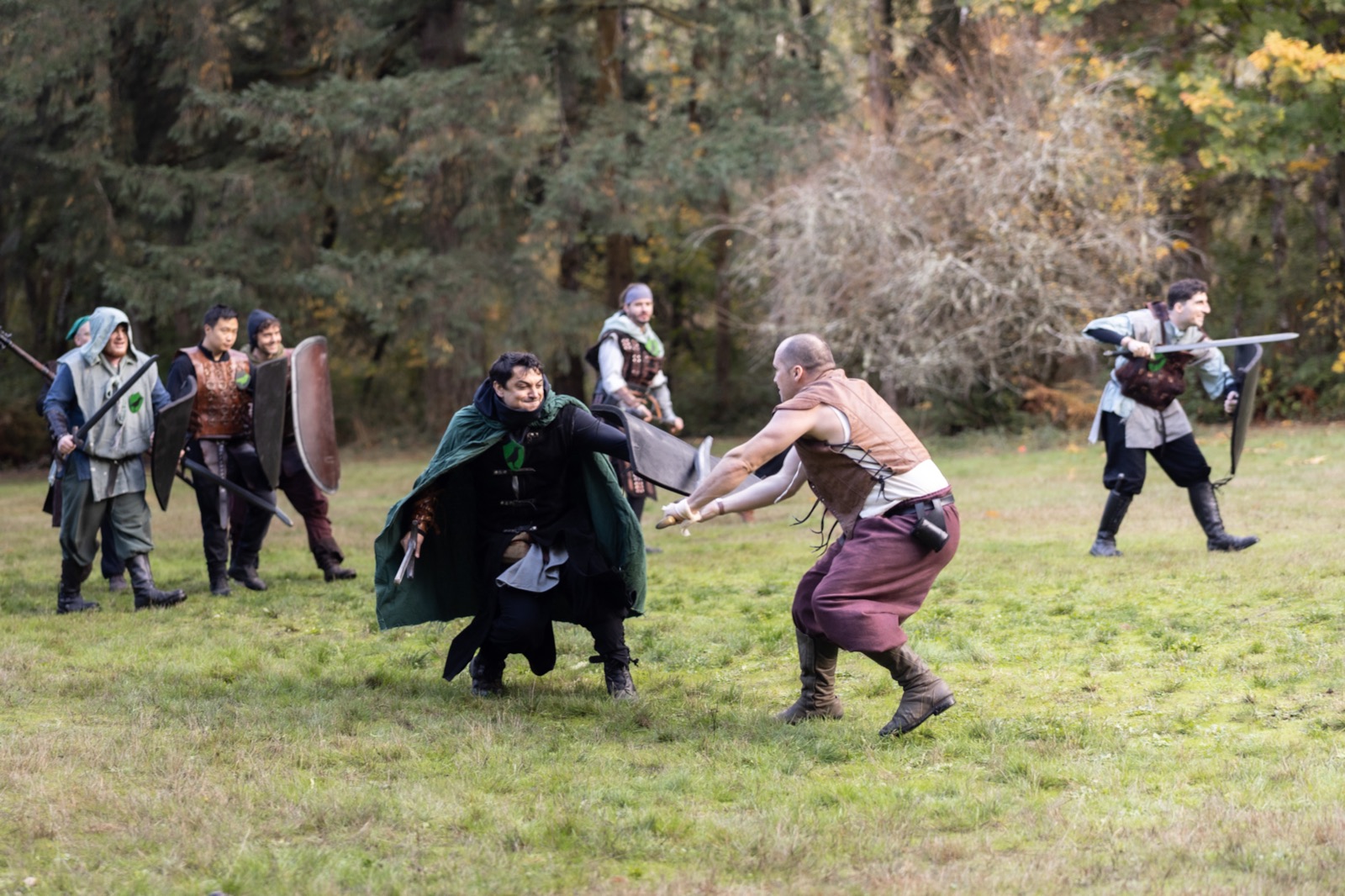
Eldritch was a medium touch system. A tap does not count, and a strike needs firm, unimpeded contact with a legal target. Avoid the head and groin. The hilt and pommel are not striking surfaces. Except with a dagger, rapier, spear, or claw, swings must come from beyond 45 degrees relative to your opponent.
Ruling, June 2025. You must wait one second between strikes against an opponent. In group combat, all opponents of one target share that second, and the target only has to take one strike per second. It had previously been a recommendation.
Ruling, June 2025. Never thrust the point of a cored weapon at an opponent, not even a spear. This replaces older text that allowed all weapons to thrust. Two-handed weapons strike with controlled swings or firm taps to the side. Non-core weapons, such as small knives, may mime a stab or be thrown.
Blocking
A block works when a shield or weapon resoundingly stops the motion of the strike. Swinging hard enough to blow through a block is not allowed. The defender always decides. If you believe an opponent is not taking hits, keep playing and tell a staff member afterward. Calling it out during the fight is never acceptable.
The Break
You may not corner an opponent or stay inside arm's length to land strikes. If someone does this to you, say "Break," and they must step back at least three feet. Abusing this call is a conduct issue.
Weapons
- One-handed weapons are 43 inches or shorter. Anything longer is two-handed.
- A two-handed weapon may be held in one hand, but its two-handed skills then cannot be used.
- Weapons and shields absorb a set number of Sunder skills, listed on their item cards.
- Homemade weapons and shields are not allowed, except the claw type.
- Approved makers are Calimacil, Dark Knight Armoury, Epic Armoury, Mytril, Atelier Nemesis, Medieval Collectibles, Mytholon, and Buzzbee. Others need approval from staff.
Ranged Weapons
Every ranged weapon needs the matching Martial skill. Ammunition is finite and is bought in bundles during the game.
| Weapon | Effect of a hit | Requirements |
|---|---|---|
| Bow | Bypasses all Armor Value. Resist may not negate it. Shields block arrows as they block any weapon. | 24 to 72 inches, with a draw weight of 35 pounds at most |
| Pistol | The target goes straight to the Dying count. A shield may block the shot but takes a Sunder, which cannot be Resisted. | Buzzbee or similar, flintlock style, one foam dart or ball per shot, with a pop-cap for sound. Non-masterwork pistols may not fire in rain. |
| Thrown | As a melee weapon. | 12 inches or shorter, with no core |
Traps
A trap needs its item tag and a device that an offending player can trigger, such as a mouse trap and string, pop-its, or a bell. Damage beyond Armor Value goes to legal locations of the target's choice.
| Color | Damage |
|---|---|
| Green | 4 |
| Blue | 8 |
| Red | 12 |
Safety
Staff saw that fear and adrenaline made players swing too hard, and volunteers playing NPCs took bruises and minor injuries as a result. Players were reminded that no one's life is at stake and that a fight exists to entertain everyone in it.
- Agree in advance on any move outside normal fighting, such as a slashed throat, a shield charge, or the use of terrain. Staff or a marshal can settle a disagreement.
- Shield bashing no longer involves striking another player with a shield.
- A staff member or safety marshal may ask you to step out of a fight and talk.
- After more than two safety warnings, a player may be banned from boffer combat. That player may still attend and play, and must excuse themselves from fights.
Unsafe force, griefing, and harassment fell under the code of conduct.
Opting Out
Physical combat at Eldritch was opt-out, because medium touch strikes can sting. Non-combatants wore an orange reflective sash, with optional orange glow sticks at the wrists after dark. They could put these on or take them off at any time. No one could physically strike a player wearing them.
An attacker who wanted to fight a non-combatant announced the attack and named a place on the body, and the two played rock-paper-scissors. If the attacker won, the hit landed. If the defender won, the attack missed, and the defender could disengage for a full minute or counterattack with a weapon skill. PVP rules still applied.
The tavern and kitchen were permanent non-combat zones. Safe hours ran from 2 AM to 8 AM, when no combat or PVP could take place inside cabins.
The published policy noted that the rock-paper-scissors system had not been tested when it was written.